by rakesh | Aug 30, 2006 | Rajasthan
The Relief Minister, Dr. Kirori Lal Meena informed this at a press briefing here on Wednesday. He said that Rs. 1.34 crores had been demanded for ex-gratia payment to families of deceased persons, Rs.124.27 crores for repair and restoration assistance for damaged houses, Rs.333.99 crores for immediate restoration of roads, Rs. 53.30 crores for restoration of drinking water supply, Rs.37.11 crores for restoration of water resources, Rs.28.77 crores for restoration of damaged tanks of PRIs, Rs. 520.65 crores for input subsidy to affected farmers, Rs.106.56 crores for medical and health care and Rs.212.24 crores for veterinary health care for livestock & replacement subsidy of dead animals.
Dr. Meena informed that Rs. 74.65 crores had been asked for restoration of power supply network, Rs.400 crores for miscellaneous things including damage to the mining and relocation of submerged villages, Rs.1230.08 crores for wage employment to affected families, Rs.10 crores for air dropping of essential services and hiring helicopters, Rs. 2 crores for evacuation of people affected, Rs. 10 crores for temporary accommodation, food and clothing and Rs. 50 crores for draining of flood water in affected areas.
The Relief Minister said that Rs. five crores had been demanded as cost for search and rescue and Rs. one crore as cost of clearance of debris.
The Secretary Relief Shri R.K. Meena informed that the State Government had spent Rs. 536.42 crores on relief operations so far. He said that state had an opening balance of Rs. 51.52 crores in the calamity relief fund in the year 2004-05. He said that the state received 163.66 crores from the Centre and after including the state share of Rs.54.55 crores the total Rs.218.21 crores were with the State Government. Thus over Rs.318 crores more had been spent in relief operation so far, he added.
by rakesh | Aug 30, 2006 | World News
A team led by Eun-Su Yang of the Georgia Institute of Technology, Atlanta, analyzed 25 years of independent ozone observations at different altitudes in Earth’s stratosphere, which lies between six and 31 miles above the surface. The observations were gathered from balloons, ground-based instruments, NASA and NOAA satellites.
The stratosphere is Earth’s second lowest atmospheric layer. It contains approximately 90 percent of all atmospheric ozone. The researchers concluded the Earth’s protective ozone layer outside of the polar regions stopped thinning around 1997. Ozone in these areas declined steadily from 1979 to 1997.
The abundance of human-produced ozone-destroying gases such as chlorofluorocarbons peaked at about the same time (1993 in the lowest layer of the atmosphere, 1997 in the stratosphere). Such substances were phased out after the 1987 international Montreal Protocol was enacted.
To measure ozone at different altitudes in the stratosphere, the team combined data from balloons and independent ground-based observing networks with monthly averaged satellite data. The satellite data came from five independent NASA and NOAA instruments.
Measurements were compared with computer predictions of ozone recovery that considered actual measured variations in human-produced ozone-destroying chemicals. The calculations took into account other factors that can affect ozone levels, such as sunspot cycle behavior, seasonal changes and stratospheric wind patterns.
“These results confirm the Montreal Protocol and its amendments have succeeded in stopping the loss of ozone in the stratosphere,” Yang said. “At the current recovery rate, the atmospheric modeling community’s best estimates predict the global ozone layer could be restored to 1980 levels — the time that scientists first noticed the harmful effects human activities were having on atmospheric ozone — some time in the middle of this century.”
The researchers concluded approximately one half the observed ozone change was in the region of the stratosphere above 11 miles and the rest in the lower stratosphere from six to 11 miles. The researchers attribute the ozone improvement above 11 miles almost entirely to the Montreal Protocol.
“Scientists expected the Montreal Protocol to be working in the middle and upper stratosphere and it is,” said co-author Mike Newchurch of the University of Alabama in Huntsville. “The real surprise of our research was the degree of ozone recovery we found at lower altitudes, below the middle stratosphere. There, ozone is improving faster than we expected, and appears to be due to changes in atmospheric wind patterns, the causes of which are not yet well understood. Until the cause of the recent ozone increase in the lowermost stratosphere is better understood, making high-accuracy predictions of how the entire ozone layer will behave in the future will remain an elusive goal. Continued careful observation and modeling are required to understand how the ozone recovery process will evolve.”
“Our study is unique because it measures changes in the ozone layer at all heights in the atmosphere, then compares the data with models as well as observations from other instruments that measure variations in the total amount of ozone in the atmosphere,” said Ross Salawitch, a senior research scientist at NASA’s Jet Propulsion Laboratory, Pasadena, Calif.
Results are published in the latest Journal of Geophysical Research.
by rakesh | Aug 29, 2006 | World News
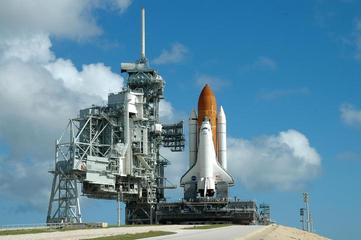
The decision was made due to Tropical Storm Ernesto’s track. Ernesto is expected to bring high winds as it passes Kennedy.
A new launch date is not yet scheduled for Atlantis’ flight, STS-115, to the International Space Station. NASA and the Russian Federal Space Agency continue to discuss the timing of Atlantis’ mission and the Soyuz spacecraft, which will send the next crew to the station in
September. Factors to be considered are the lighting constraints for the shuttle launch and Soyuz landing and the timing for docking and undocking the spacecraft with the station. NASA is also investigating additional launch windows later in the fall.
The STS-115 crew will return to NASA’s Johnson Space Center, Houston. Commander Brent Jett, Pilot Chris Ferguson, and mission specialists Joe Tanner, Dan Burbank, Heide Stefanyshyn-Piper and Canadian astronaut Steve MacLean will continue training as they await a new target launch date.
During STS-115, Atlantis’ astronauts will deliver and install the 17.5-ton, bus-sized P3/P4 integrated truss segment on the station. The girder-like truss includes a set of giant solar arrays, batteries and associated electronics. The P3/P4 truss segment will provide one-fourth of the total power-generation capability for the completed station.
by rakesh | Aug 29, 2006 | Rajasthan
Smt. Raje made this announcement at the meeting of the All Rajasthan State Employees Sanukata Mahasangh (Ekikrita) held at Gandhi Nagar Club here on Monday. She said that the pensioners would also be benefited. The State Government would have to bear an additional financial burden of Rs. 245 crores in the current financial year with this announcement. The PWD Minister, Shri Rajendra Rathore and the Irrigation Minister, Prof. Sanwar Lal Jat were also present on the occasion.
Speaking on the occasion, Smt. Raje said that the relation between the employees and the government was like a family and she would always keep in mind the interests of the employees, but in return she also expect every type of cooperation, hard work and honesty from the employees. She said that the situation of flood in the western area of the state had posed a serious challenge infront of the State Government. She informed that Rs. 30 crores had already been spent on flood relief and Rs. 100 crores had been approved for the purpose. She sought the cooperation of the employees in this hour of crisis.
The Chief Minister said that the State Government had constituted a committee under the Chairmanship of Shri S.N.Gupta with the view to increase coordination between employees and the government and to improve their skills. She said that the committee would maintain a regular contact between the government and the employees and suggest measures in the interest of the employees.
The employees present during the meeting raised their hands in support on the Chief Minister’s appeal for cooperation.
The Chairman of the Sanukata Mahasangh (Ekikrita) Shri Mahendra Choudhary welcomed the announcement of the Chief Minister regarding three percent increase in the dearness allowance and thanked her.
by rakesh | Aug 28, 2006 | Indian Stock Market
FII trading activity on NSE and BSE on Capital Market segment The following is combined FII trading data across NSE and BSE collated on the basis of trades executed by FIIs on NSE and BSE on 28-Aug-2006. The data is provisional in nature and is subject to changes,...