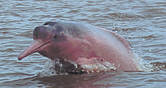
The pink river dolphin
The survey, led by Colombian conservation NGO Fundación Omacha, with support from WWF, the Wildlife Conservation Society, Fundación La Salle and the Whale and Dolphin Conservation Society, counted 33 pink river dolphins and seven gray river dolphins during an expedition through the Ecuadorian Amazon, along the Napo, Lagarto Cocha, Cuyabeno and Yasuni Rivers.
“We are pleased that we have sighted a good number of these vulnerable freshwater species,” said Fundación Omacha Director Fernando Trujillo, “but we are still very concerned about threats that are affecting overall population numbers.”
River pollution, deforestation, indiscriminate capture and incidental fishing are some of the factors affecting the South American river dolphins. Oil exploration is also a factor.
“Aquatic ecosystems are particularly vulnerable to direct and indirect impacts from this activity, mostly because it pollutes the rivers and increases the number of motor-driven vessels,” said Victor Utreras of the Wildlife Conservation Society.
“Dolphins are very sensitive to acoustic pollution and threatened by collisions with fast moving vessels.”
The South American river dolphin survey expedition, which consists of scientists from Colombia, Peru, Ecuador, Bolivia and Venezuela, started in May in the Venezuelan city of Ciudad Bolivar. Following the recent freshwater dolphin survey in Ecuador, another expedition will take place in the Meta River in Colombia in August, followed by two more in Peru and Bolivia in September.
The overall aim of the survey is to establish how many river dolphins there are in the Amazon and Orinoco Rivers and their tributaries.
“Along with estimates of river dolphin populations, we are also gathering as much information on potential threats and conservation status on the species in the areas we visit,” said Saulo Usma, WWF Colombia’s Freshwater Coordinator.
“This information will contribute to the design of management plans and specific conservation actions in the headwaters of the Amazon.”
END NOTES:
• The pink river dolphin (Inia geoffrensis), also known as the boto, is found in lowland fast flowing, white-water rivers, clearwater or blackwater rivers. The species is also present in the largest tributaries, lakes, confluences and seasonally flooded forests. It depends on healthy fish populations for its survival. Historically, the boto has been spared human persecution because of the belief that it has special powers. Today however, it is increasingly viewed by fishermen as an unwanted competitor for fish. The boto can get tangled up in fishing nets, or suffer wounds by colliding with boats. In addition to spotting the pink river dolphin, scientists are also on the look out for the gray river dolphin (Sotalia fluviatilis) — a dolphin species darker and smaller than the boto, with a shorter snout and a distinctive triangular dorsal fin.
For further information:
Maria Ximena Galeano, Press Officer
WWF Colombia
Tel: +57 2 558 2577
Email: mxgaleano@wwf.org.co