
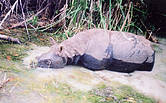
Baby boom for world’s rarest rhino species
Signs of the rhino calves were discovered in Indonesia’s Ujung Kulon National Park by a team of biologists, including park rangers and WWF staff, and local people checking on the rhinos after the recent earthquake on the island of Java. These are the first known births for the Javan rhinos in three years.
“Javan rhinos are probably the rarest large mammal species in the world and they are on the very brink of extinction,” said Arman Malolongan, Director General of Forest Protection and Nature Conservation at Indonesia’s Ministry of Forestry.
“To discover that this population is breeding, and even slowly growing, gives us hope for the species’ future.”
Javan rhinos are the rarest of the world’s five rhino species and are critically endangered. It is estimated that between 28 and 56 Javan rhinos live in Ujung Kulon. The only other known population is in Cat Tien National Park in Vietnam, where no more than eight rhinos are thought to survive.
The team found the first sign of a calf a few weeks ago, with the discovery of a small footprint (about 16–17 cm) along with a larger footprint belonging to the mother. One day after this first discovery, another set of mother and calf footprints of slightly different size was found in a different area. Both signs were estimated to be three days old or less. On the same day, a second team came face-to-face with a mother and female calf. And the following day, the team found a fourth small footprint in a different location.
Because of the distance between the four areas where the discoveries were made and the differences in the size of the footprints, the team concluded they are evidence of four different calves.
“Javan rhinos live deep inside the rainforest and it’s very unusual to catch a glimpse of them,” said Adhi Rahmat Hariyadi, WWF-Indonesia Site Manager in Ujung Kulon National Park.
“Our team was lucky to actually be able to observe a mother and calf in the Ujung Kulon Peninsula while checking camera traps installed in the area.”
WWF and park staff hope to capture photos of the newborns from remote-triggered camera traps used to monitor the rhinos.
With this new evidence that the Javan rhino population in Ujung Kulon is breeding, WWF recommends that the park authorities find ways to reduce the main threats to this rare species, such as habitat and food competition with wild cattle within the park, and invasive vegetation that limits the expansion of the rhinos’ favoured food sources. WWF also calls for the establishment of a second population of Javan rhinos outside the park to protect the species from disease or natural disasters that could wipe out the entire population.
The Future is Rural Banking
According to Diamond Management and Technology Consultants (NASDAQ:DTPI) , a retail banking system that serves more rural customers can be an attractive business proposition. The World Bank estimates that credit demand in rural areas is approximately Rs 1,330 billion and other studies put that figure as high as Rs 1,500 billion. Furthermore, a large market remains untapped in both the liability (approximately Rs 215 billion) and asset (approximately Rs 1,204 billion) sides of the banking business.
Diamond outlines the scope of the opportunity in a new whitepaper, “Building a More Inclusive Financial System in India,” available upon request via an e-mail to: RuralBanking@diamondconsultants.com.
Overcoming Problems of Access to Banking Services
“There are some 32,000 commercial bank branches in India but they cover less than seven percent of the total villages in the nation,” said Vijay Mulbagal, a consultant in Diamond’s financial services practice in India. “Operating branches in many villages is simply too expensive to warrant the investment, but there are alternatives that can serve the interests of both rural customers and the banks.”
Banks have traditionally viewed the higher cost of serving rural customers, their higher credit risk, and a lack of information about customer behavior as barriers to providing greater access. For banks to view rural India as a growth opportunity, a number of access issues must be addressed. Physical infrastructure (electricity, transportation, telecommunications) is a major stumbling block. Regulatory constraints imposed by the Reserve Bank of India, such as the rule prohibiting staffing anyone other than a security guard at an ATM, inadvertently undermine access to banking services.
“There’s no one ‘right’ channel or solution to improve access,” said Mulbagal. “But it is possible to come up with an innovative cost-effective approach that creates greater access for rural customers, while satisfying a bank’s financial goals.”
According to the Diamond report, a combination of banking channels might include:
— Business correspondents or other authorized groups who could assist
with loan applications, nurture self-help and joint liability groups,
collect small-value deposits, and deliver small-value remittances.
— Secure mobile bank branches that visit villages on specified days and
deliver many of the same services as more expensive satellite offices
or bank branches.
— Low-cost, custom-made ATMs, managed by business correspondents that
would provide a cost effective scalable solution for rural areas.
Encouraging Greater Usage of Banking Services is Possible
Diamond notes that even with access to formal banking services there is no guarantee that they will be used by rural customers. Banks that have succeeded in capturing significant market share in urban environments must rethink their customer service model to match the needs of rural customers.
“Rural customers in particular need the capability to establish micro- savings accounts and withdraw funds frequently. However, the costs of opening and operating an account are high, particularly when you also consider the expense of traveling to a branch, and the opportunity cost of lost wages,” said Andrew Sofield, a Mumbai-based Manager in Diamond’s financial services practice.
Sofield noted that while banks commonly offer personal loans and credit cards to urban customers, those services are significantly restricted in rural areas, forcing rural customers to raise loans through the informal financial system.
“Even though rural customers may have a good track record of repaying loans, excessive documentation and time-consuming processes discourage customers from going through commercial banking channels,” Sofield said.
In its whitepaper Diamond offers specific suggestions for improving the convenience of banking for rural customers. These include early morning or late evening banking hours at rural branches and the provision of signature- ready deposit and withdrawal slips which require thumb impressions.
In addition, Diamond recommends that banks clearly define eligibility criteria and create credit scoring systems that take into account the irregular cash flows of farmers and other rural customers.
Government, Reserve Bank Must Get Involved
Commercial banks can’t go it alone, the Diamond report contends. The Central and State governments and the Reserve Bank of India have important roles to play in building a more inclusive banking system. The Bharat Nirman plan to improve transportation and power infrastructure in rural communities is an important first step in improving access to banking services. Rigorously enforcing the Moneylenders Act and educating rural customers about the benefits of using formal banking channels are also necessary. As regulator of the formal banking system, The Reserve Bank of India may have to re-examine some of its regulations governing the licensing of new branches, operations of ATMs and the use of technology.
“Usage and access issues that prevent more than 150 million bankable adults in rural areas from using formal banking channels can be overcome,” said Vinod Nair, Managing Partner of Diamond’s practice in India. “It will take a collaborative effort by the banks, the government and the RBI to serve the rural market. We think there’s a win/win opportunity for rural customers and banks if the banks are willing to take the initiative now.”
