by rakesh | Sep 21, 2006 | Env & Geography
Rabies is mainly a problem of developing world – Asia and Africa where 99% of all human deaths estimated to be over 50,000 occur globally every year. Though the exact statistical data is not availwable but it is estimated that in India alone approximately 20,000 people die of Rabies every year, besides it causes a large number of deaths in domestic and wild animals. Moreover, there is a huge expenditure incurred on post- exposure vaccination. Therefore, there is an urgent need to control and finally eradicate this dreaded disease from India as has been achieved by several South-East Asian countries like Malaysia and Singapore.
The main vector of rabies in India is the dog. The twin strategies to control and eradicate rabies in India will be:
a) To achieve at least 80% prophylactic immunization of dog population (owned / stay / community)
b) To push forward the existing ABC/AR programme for stray/ community dogs on war footing to control their population.
The WHO at its Fourth International Symposium on Rabies Control in Asia stated:
“Elimination of Rabies in human requires control of rabies in dogs”. Dr. F.X. Meslin of the Communicable Diseases Surveillance Department of WHO says: “Rabies elimination by vaccination of the dog population is the most cost beneficial strategy.” It has also been repeatedly stressed that once we reach the threshold figure of 70% of a dog population being vaccinated, the propagation of rabies is virtually halted.
The Animal Welfare Board of India, Ministry of Environment and Forests is presently engaged in controlling the population of stray dogs through its Animal Birth Control/Anti-Rabies inoculation programme(ABC/AR) being carried out through the medium of NGOs, SPCAs and AWOs throughout the Country. Over 70,000 stray/community dogs are being sterilized/ neutered every year and given Anti-Rabies vaccine. These dogs are relocated to their original habitat with efforts of local bodies after the sterilization. This programme has significantly reduced the incidence of Rabies in several Metros such as Delhi, Jaipur, Mumbai, Pune, Chennai, Hyderabad, Banglore, Kalimpong & Kolkata.
One of the major problems encountered in control of rabies is the mass immunization of stray/community dogs which are not accessible for injectable rabies vaccine – recommended by WHO for immunization of stray/community dogs – the problem can now be addressed.
WHO also recommended controlling the rabies population of dogs through ABC programme rather than killing them, which is inhuman and does not go well with our culture ethos of love and compassion for animals.
The entire success of this project rests on the realm of local Municipal bodies, Rural Administration and State Veterinary Services which come under the State Governments.
by rakesh | Sep 19, 2006 | Env & Geography
“Solar-B will record how energy stored in the solar magnetic field is released as that field rises into the sun’s outer atmosphere,” said Larry Hill, Solar-B project manager at NASA’s Marshall Space Flight Center, Huntsville, Ala.
Solar-B’s three instruments — the Solar Optical Telescope, the X-Ray Telescope and the Extreme Ultraviolet Imaging Spectrometer — will perform coordinated measurements of the different layers of the solar atmosphere. Continuous, simultaneous observations of specific solar features by all three instruments will enable Solar-B to observe how changes in the magnetic field at the sun’s surface spread through the layers of the solar atmosphere.
JAXA is the overall lead for the Solar-B mission, the spacecraft, the launch vehicle and management of space operations. NASA provided the Focal Plane Package for the Solar Optical Telescope, and components for the Solar X-ray Telescope and the Extreme Ultraviolet Imaging Spectrometer, as well as engineering support for integration of the instruments.
The Solar Optical Telescope will be the first space-borne instrument to measure the strength and direction of the sun’s magnetic field in the sun’s low atmosphere, also called the photosphere.
The sun’s outer atmosphere, the corona, will be captured by the X-ray Telescope. The corona is the spawning ground for solar flares and coronal mass ejections. Powered by the sun’s magnetic field, this explosive solar activity produces significant effects in the space between the sun and Earth. By combining observations from Solar-B’s optical and X-ray telescopes, scientists will be able to study how changes in the sun’s magnetic field trigger these powerful events.
The Extreme Ultraviolet Imaging Spectrometer will measure the speed of solar particles. The spectrometer provides a crucial link between the other two instruments, measuring the layers that separate the photosphere from the corona – an area known as the chromosphere and the chromosphere-corona transition region. The spectrometer will also be able to measure the temperature and density of solar plasma – the hot, ionized gas surrounding the sun.
“The information that Solar-B will provide is significant for understanding and forecasting of solar disturbances, which can interfere with satellite communications, electric power transmission grids, and threaten the safety of astronauts traveling beyond the safety of the Earth’s magnetic field,” said John M. Davis, Solar-B project scientist at NASA Marshall.
After its launch from Uchinoura Space Center in Kagoshima, Japan, the Solar-B spacecraft will circle Earth in an orbit that places the instruments in continuous sunlight for nine months each year. Following launch, NASA and the science teams will support instrument operations and data collection from the spacecraft operations center at JAXA’s Institute of Space and Astronautical Science facility.
NASA; Lockheed Martin, Palo Alto, Calif.; the High-Altitude Observatory, Boulder, Colo.; JAXA’s Institute of Space and Astronautical Science (JAXA/ISAS), Sagamihara, Japan; and the National Astronomical Observatory of Japan (NAOJ), Tokyo, participated in the development of the instrumentation for the Solar Optical Telescope. The X-ray Telescope was built by the Smithsonian Astrophysical Observatory, Cambridge, Mass.; JAXA/ISAS; and NAOJ. The spectrometer was developed by the Mullard Space Science Laboratory of the University College London, United Kingdom; the Naval Research Laboratory, Washington; and NAOJ.
Solar-B is a collaboration among the space agencies of Japan, U.S., the United Kingdom and Europe. The mission is part of the Solar Terrestrial Probes Program within the Heliophysics Division of NASA’s Science Mission Directorate in Washington.
by rakesh | Sep 17, 2006 | Env & Geography
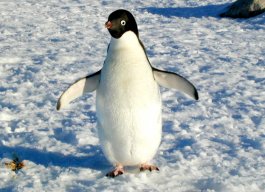
Males and females are of similar size and are difficult to tell apart without internal examination.
Adélie penguins breed between October and March on areas of rock in colonies of varying size. They start breeding at 3-5 years of age and live up to 20 years.
They make nests out of small stones, lay two eggs, and raise up to two chicks per nest, depending on food availability. Chicks are about two months old when they fledge.
Males and females share incubation and chick rearing duties almost equally.
Adélie penguins feed mainly on krill (Euphausia crystallorophias and E. superba), but will also eat fish, squid and other crustaceans.
Breeding adults travel between 5 and 120 km offshore to catch food for their chicks. Feeding trips range from 5 to 72 hours in duration.
Adélie penguins are capable of diving to depths of up to 175m but usually feed within the upper 70m of the water column.
Written by Judy Clarke, AMLR Program, and Maria Clippingdale, AADC.
© Australian Antarctic Division 2006
Kingston Tasmania 7050
by rakesh | Sep 17, 2006 | Health & Fitness
More than 1.1 billion people in both urban and rural areas currently lack access to drinking water from an improved source and 2.6 billion people do not have access to even basic sanitation, the report shows. The health impact of this can be seen particularly in children. WHO estimates that in 2005, 1.6 million children under age 5 (an average of 4500 every day) died from the consequences of unsafe water and inadequate hygiene.
Children are particularly at risk from water-related diseases such as diarrhoeal and parasitic diseases. Lack of sanitation also increases the risk of outbreaks of cholera, typhoid and dysentery.
The populations of urban areas in the developing world are growing rapidly and, if the MDGs are to be met, a huge amount of work will have to be done simply to maintain the proportion of those living in cities with access to improved drinking water and adequate sanitation. Currently, 95% of city dwellers have access to an improved source of drinking water, while 80% have access to sanitation services.
Meeting the water and sanitation targets of the Millennium Development Goals (MDGs) will be one of the most effective means of raising the health and general living standards of many of the world’s poor. But reaching the water and sanitation targets will require much greater efforts by policy makers, funding and training agencies, planning and construction. These solutions must focus on poor and underserved people worldwide, WHO warns. In 2000, the world pledged to reduce by half the proportion of people without sustainable access to safe drinking water and basic sanitation. According to the report, MDG Drinking Water and Sanitation Target – The Urban and Rural Challenge of the Decade, to meet the sanitation MDG will require a doubling of current efforts. A one-third increase in efforts will be needed to meet the MDG drinking water target.
“It is a tragedy that the world may not reach the water and sanitation MDGs. Safe drinking water and basic sanitation are so obviously essential to health that they risk being taken for granted,” said Dr Anders Nordström, Acting Director-General of WHO. “Efforts to prevent death from diarrhoea and other diseases are doomed to failure unless people have access to safe drinking water and basic sanitation. This report underlines the importance of the new WHO strategy on public health and environment to radically reduce the global burden of disease through preventive health measures. Only by tackling the root causes of diseases such as water and sanitation can we reduce the 24% global burden of global disease caused by the environment.”
Sub-Saharan Africa is still the main focus of concern. An estimated 80% of people without access to an improved drinking water source live in sub-Saharan Africa, Eastern Asia and Southern Asia. Due to population growth over the period from 1990–2004, the number of people without access to drinking water in Sub-Saharan Africa increased by 23%. Currently, just 56% of the population has access to an improved water supply. Just 37% of people in sub-Saharan Africa had access to basic sanitation in 2004, compared to a global average of 59%.
In rural areas, access to an improved source of drinking water and to basic sanitation services was very low in 1990 (the baseline year for measuring the MDGs): only an estimated 64% had access to a drinking water source, while 26% had access to sanitation services. While those percentages rose substantially by 2004 – to 73% and 39% respectively – these numbers still fall way short of what is needed to achieve the MDGs.
From the report comes one example of a success story in terms of raising coverage. In Ethiopia, the Amhara region had a coverage rate for access to sanitation services of only 3.8% in 2003, and only 100 latrines were being constructed annually in each district. In that year, the government initiated a social marketing campaign which increased community knowledge and understanding of sanitation and its linkages to health. Community demand for latrines sky-rocketed, and by 2005, the average number of latrines constructed per district was 26 400.
by rakesh | Sep 17, 2006 | Health & Fitness
The OzonAction Education Pack, launched globally today in English, French and Spanish, contains an entire teaching and learning programme, based on basic knowledge, practical skills and participation, to enable children to learn about simple solutions to protect the ozone layer and safely enjoy the sun.
“While we have hope that the atmosphere is healing and that the Montreal Protocol is working, we are still facing serious challenges,” said Achim Steiner, UN Under-Secretary General and Executive Director of the United Nations Environment Programme (UNEP). “Children should be aware of the huge risks that a weakened ozone layer poses to human health and the environment and they must know that much remains to be done. We must give them the means to protect their own future, and education is certainly key in this regard,” he said.
The pack, produced jointly by the United Nations Environment Programme (UNEP), the United Nations Educational, Scientific and Cultural Organization (UNESCO) and the World Health Organisation (WHO), has been released to co-incide with the International Day for the Preservation of the Ozone Layer on 16th of September. This year’s theme is “Protect the Ozone Layer, Save Life on Earth”.
“The OzonAction Education Pack will help schoolchildren to become aware of the simple protection steps that reduce solar UV health risks, and these become even more important as ozone layer depletion leads to intensified UV radiation on Earth,” said Dr Anders Nordström, Acting Director-General of WHO. “The severe health effects such as melanoma and other skin cancers are largely preventable through reduced sun exposure. UV protection thus becomes an important component of the global efforts towards cancer prevention.” The ozone layer plays a crucial role in the protection of life on Earth from harmful effects of ultraviolet radiation. While some solar UV radiation is necessary for bone health and also may help to prevent certain chronic diseases, excessive sun exposure causes immediate and long-term health problems.
Sunburn – which can be severe and blistering – is an acute health problem, while skin cancer and cataract leading to blindness are the most severe long-term health effects. WHO estimates that about 1.5 million DALYs are lost every year due to excessive solar UV radiation. One DALY is equivalent to one lost year of life in full health.
The OzonAction Education Pack is also linked to the UN Decade of Education for Sustainable Development, which is led by UNESCO.
“The United Nations Decade of Education for Sustainable Development (2005-2014) aims to integrate the values inherent in sustainable development into all aspects of learning to encourage changes in behaviour which will enable a more viable and fairer society for everyone,” said Koïchiro Matsuura, Director-General of UNESCO. “During this Decade, education for sustainable development will help to make citizens better prepared to face the challenges of the present and the future, and to orient decision-makers in their efforts to create a viable world.”
UNEP, UNESCO and WHO are jointly promoting the OzonAction Education Pack to countries around the world and encouraging Environment, Education and Health Ministries, schools and teachers to adopt it as part of the primary school curriculum.
The signing of the Montreal Protocol on Substances that Deplete the Ozone Layer on 16 September 1987 is now celebrated every year as the International Day for the Preservation of the Ozone Layer.
The development of the Education Pack was led by the OzonAction Branch in UNEP’s Division of Technology, Industry and Economics and it was financially supported by the Multilateral Fund for the Implementation of the Montreal Protocol.
Page 32 of 53« First«...313233...»Last »